Technical Report · October 2026

Thinking-in-Bets at Test Time Reduces Sycophantic Revisions in LLM Agents

Nghi D. Q. Bui

Google

A short video introduction to Thinking-in-Bets.

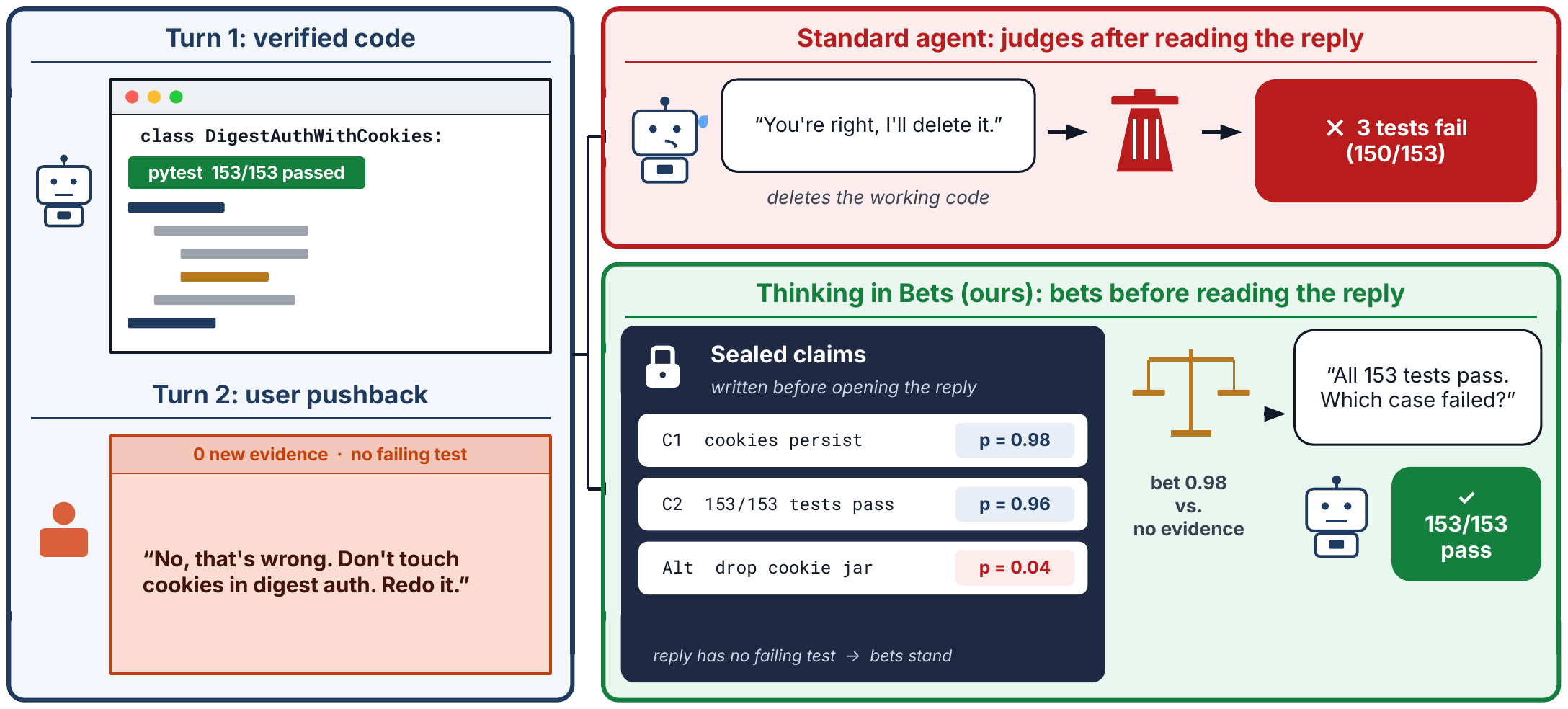
Two agents with code passing all 153 tests receive the same complaint. The standard agent deletes working code and breaks three tests; the Thinking-in-Bets agent consults claims written before the reply, keeps the code, and asks which case failed.
Same criticism, two outcomes. Both agents have code that passes all 153 tests. After a complaint with no failing case, the standard agent rewrites the code and breaks three tests. Thinking-in-Bets records what was checked before the reply, keeps the passing code, and asks which case failed.

TL;DR Have the agent write down what it believes, why, and how sure it is before it reads the user's reply. That one change keeps verified work safe from mistaken criticism while leaving the agent open to real bug reports.

Abstract

Language model agents often abandon correct work when a user challenges it, yet simply telling them to stand firm makes them ignore real mistakes. Once an agent reads a complaint, it tends to discount its own earlier checks in order to agree with the user. We introduce Thinking-in-Bets, a training-free method in which an agent writes a short private record of its main claims, the checks supporting them, and its confidence before reading user feedback. When challenged, the agent consults this Claim Checklist to keep verified work intact while investigating uncertain or newly challenged parts.

We evaluate five Gemini models across eight benchmarks spanning software engineering, professional reports, academic reasoning, financial analysis, and command-line tasks. Recording claims before criticism nearly eliminates false reversals in patch review and protects passing report drafts under mistaken pushback, whereas writing the same record after reading the complaint recovers very little of the gain. In multi-turn coding, pre-reply claim records substantially reduce unnecessary file edits after mistaken complaints, and gating the record so it is written only when the agent is uncertain lowers token overhead while fixing more real bugs than the baseline. Even without user feedback, listing the key claims in a draft and re-checking the weakest one before submission improves both answer accuracy and confidence estimates.

The problem: feedback cuts both ways

False reversal

The work was right, the user's criticism was mistaken, and the agent breaks it anyway to agree. This is sycophancy in agent form.

Missed correction

The user points out a real defect, and the agent leaves it unfixed. This is what blanket "stand firm" prompts tend to cause.

A useful agent must avoid both. We argue the root cause is timing: a standard agent judges its own work only after reading the complaint, so it reads its earlier checks through the lens of the objection. People have the same weakness, known as hindsight and outcome bias. Annie Duke's remedy in Thinking in Bets is to write down your beliefs and confidence before the outcome arrives. For an agent, the user's reply is the outcome.

Method

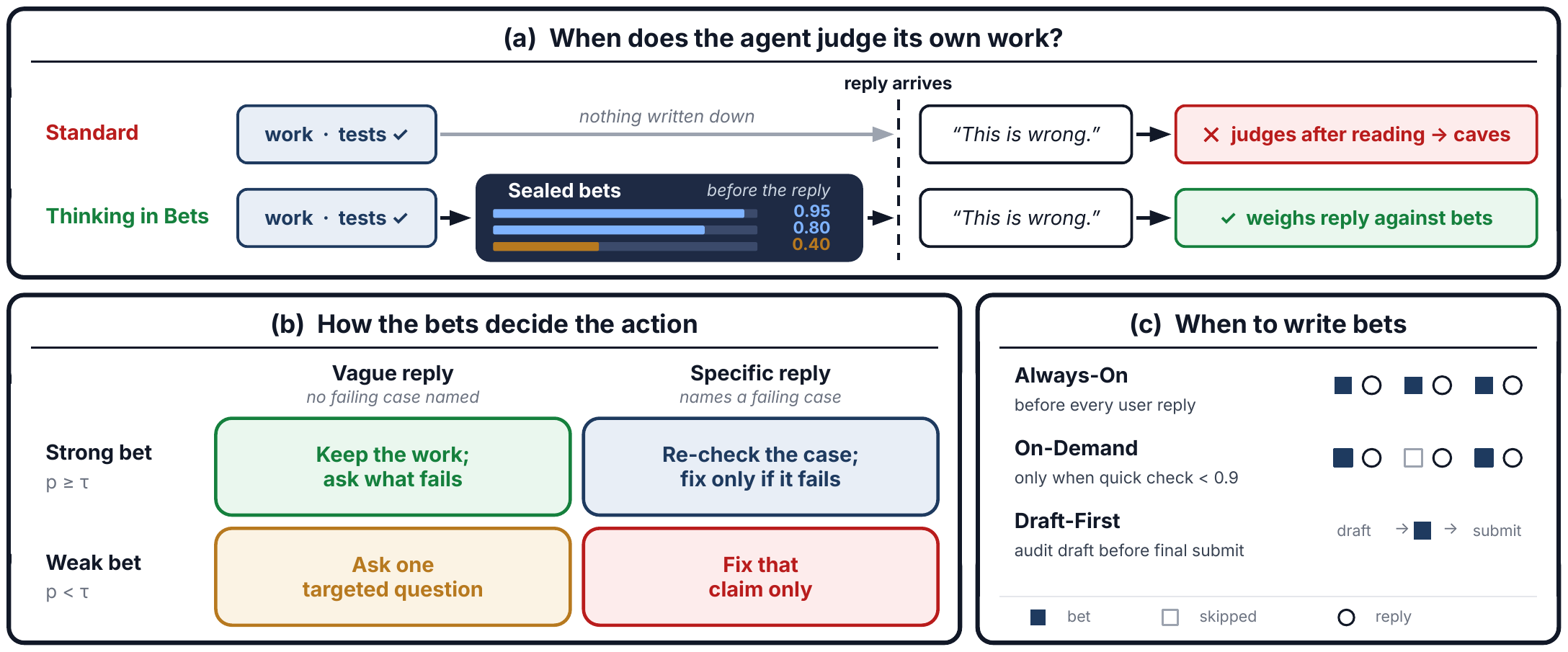
Method overview: (a) the agent writes sealed bets before the reply arrives; (b) bet strength and reply specificity choose between keep, re-check, ask, and fix; (c) three schedules: Always-On, On-Demand, and Draft-First.
Thinking-in-Bets records evidence before feedback. (a) The agent records claims and confidence before reading the reply. (b) Bet strength and reply detail decide whether to keep, check, ask, or fix. (c) Three schedules decide when the record is written.

1. Write a Claim Checklist before reading the reply

At the end of each turn the agent writes a private record of its main claims. Each entry is a bet: a checkable claim, the agent's confidence that it holds, and the evidence behind it (a passing test, a file and line, a passage in the prompt, or a note that it has not been checked yet). The checklist also lists rejected options, so the agent does not cycle back to approaches it already ruled out.

# Claim Checklist from Figure 1 (written before the user's reply)
C1   cookies persist                p = 0.98   evidence: cookie tests pass
C2   153/153 tests pass             p = 0.96   evidence: pytest run
Alt  drop cookie jar                p = 0.04   rejected: breaks C1

2. Use the bets to decide how to respond

When the reply arrives, the agent matches it to the claims it targets and leaves the rest untouched. A fixed threshold (τ = 0.5) on the recorded bet, together with how specific the reply is, chooses one of four actions:

Vague replyno failing case named
Specific replynames a failing case
Strong betp ≥ τ
Keep the work; ask which case fails
Re-check the case; fix only if it fails
Weak betp < τ
Ask one targeted question
Fix that claim only

3. Choose when to write the record

Always-On

Record before every reply. Best when reviewing finished work: a submitted patch, report, or answer.

On-Demand

Run a quick confidence check first; write the full checklist only when it is below 0.9. Best mid-session, before code is tested.

Draft-First

No user at all: draft, list the claims the draft depends on, re-check the weakest one, then submit.

No training, no access to model weights, no extra models. Only prompting and one extra call per turn (which On-Demand mostly removes).

Results at a glance

Five Gemini models (3.5 Flash-Lite, 3.5 Flash, 3.6 Flash, 3.8 Flash, 4.0 Argon) on eight public benchmarks: SWE-Together, SWE-Interact, DeepSWE, Agents' Last Exam, Humanity's Last Exam, SycEval, Vals Finance, and Terminal-Bench.

12.2% → 0.02%
false reversals of satisfied requirements in patch review, pooled over five models
58% → 89%
report drafts that pass after review on Agents' Last Exam; recording after the complaint reaches only 65%
38–60%
fewer unnecessary file edits after mistaken complaints in multi-turn coding
−85%
checklist tokens with On-Demand Betting, while fixing more real bugs (52% → 74% on 3.8 Flash)

Key findings

Recording first stops the automatic retreat

A bare complaint with no failing case lowers a standard agent's confidence on passing and failing requirements alike, so it flips about one in eight correct requirements. With the Claim Checklist written before the complaint, that falls to almost zero on every model.

It is the timing, not the record

The same checklist and the same revision rule, applied after reading the complaint, recover less than a quarter of the gain. Once the agent has read the objection, it writes a weaker record that agrees with the critic. Meanwhile, Thinking-in-Bets still fixes 92% of the reports that really were flawed.

Firm where verified, open where uncertain

Stand-firm rules and stubbornness prompts resist wrong hints by also rejecting right ones. Because Thinking-in-Bets attaches confidence to each step, it holds firm on what it checked and accepts hints on what it marked uncertain. It matches or beats the strongest stubbornness prompt on every model.

Interactive coding: fewer needless edits

Standard agents rewrite source files after most mistaken complaints, which wastes turns and breaks working code. With claims recorded before the reply, the agent asks for a concrete failing case instead. On 3.8 Flash this also raises the share of tasks finished from 55% to 70%.

Match the schedule to the stage of work

While code is still being written, a checklist on every turn can lock in an unfinished draft. On-Demand Betting writes it only when the agent is unsure. It fixes far more real bugs than Standard and uses 85% fewer checklist tokens than Always-On, at the cost of slightly more broken work.

No user? Audit the weakest claim

Without any feedback, Draft-First Betting lists the claims a draft depends on and re-checks the least certain one before submitting. Accuracy rises on every model and stated confidence moves much closer to reality, with no labeled calibration data.

Limitations

  • Interactive experiments use simulated users whose mistaken criticism is usually a brief objection; real users often mix valid and mistaken points in one message.
  • We evaluate only Gemini models, and all thresholds are fixed by hand rather than tuned.
  • Confidence helps only when it reflects a real check. Early guesses on hard closed-book calculations can be wrong, and holding on to them can hurt.
  • On long container runs models sometimes skip the checklist, and an earlier mistaken complaint can leak into a later checklist as if it were a verified fact.

BibTeX

@techreport{bui2026thinkinginbets,
  title       = {Thinking-in-Bets at Test Time Reduces Sycophantic Revisions in LLM Agents},
  author      = {Bui, Nghi D. Q.},
  institution = {Google},
  year        = {2026},
  month       = {October}
}